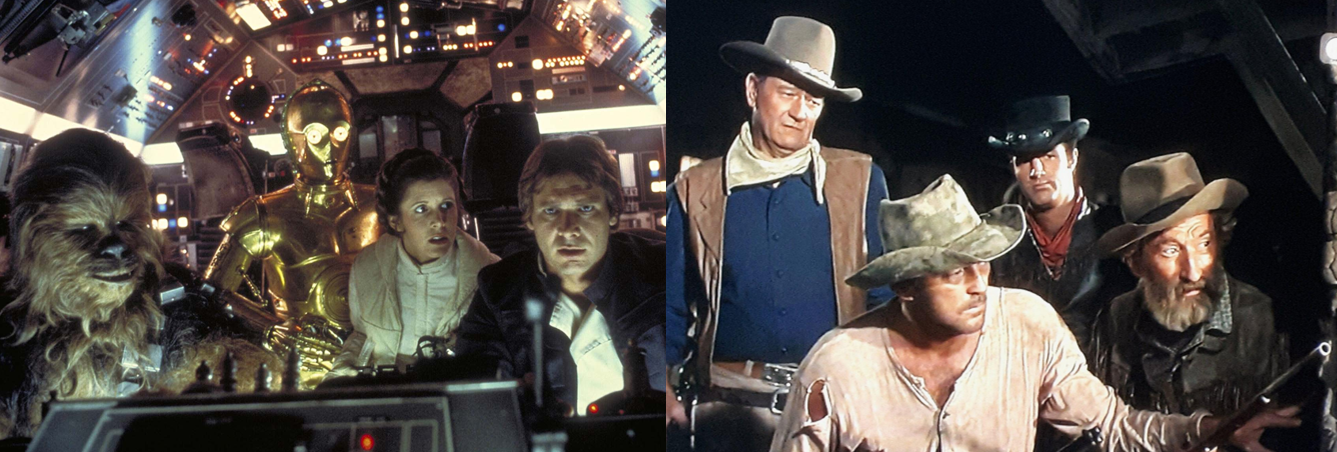

Is this why Han Solo talks like John Wayne?
Star Wars Episode V: The Empire Strikes Back (1980; Disney+)
When the rebel base is discovered, Luke travels to meet a mystic Jedi trainer while Han and Leia are on the run. It’s no wonder Toy Story 2 opens with so many references to this movie—it’s another perfect sequel. It doesn’t repeat the first movie: now it’s about the characters getting separated instead of joined together so they can grow on their own, while a few new characters on both sides add to the intrigue. It’s about going to new worlds, which are even more exciting in danger and design. It even features new music, like the Imperial March bad guy song. This is a cool sequel.
I used to not like it. It feels a little more violent, and the grit clashes with the cute, kid-friendly nods to the comic droids and innocent excitement. And the love story between Han and Leia… does she really have to fall for the “bad boy”? Cringe.
But watching it this time, I realize how good it is. The more somber scenes are ramping up the stakes in a sequel that has some big shoes to fill—but it also keeps telegraphing, “This is a family movie.” It maintains a balance of adult and kid content in an era when quality movies like this were hard to find. As for Han, he actually isn’t all that bad. Not anymore, anyway. The last movie ended as he decided to stay for his friends. He’s a lot less “solo” than he used to be. And once they get on the same page, the new couple actually have some normal human conversations. It’s okay.
The thing that most helped me see the heart behind the movie’s rough exterior was the discovery of who wrote it. It wasn’t George Lucas (who did write the basic plot). No, this screenplay was first written by a new name, whom we will discuss below: Leigh Brackett.
For sensitive viewers: A couple mild swear words. Some sci-fi action sequences where people are shot or blown up, or lose limbs, or are choked. A dead animal is cut open to provide warmth.
El Dorado (1966; free on Fawesome or Pluto)
Gunslinger Cole Thornton (John Wayne) is used to riding solo, but he’s got to get his old sheriff friend (Robert Mitchum) sobered up before the bad guys take over his town. This is the most exciting western I have ever seen. I couldn’t take my eyes off it. At every turn, something interrupts the predictable course of events, and the clock is ticking. Meanwhile, add in a young James Caan, a memorable Arthur Hunnicutt, and a villainous Ed Asner, and you’ve got a widescreen color Western adventure to blow your hat off. If it’s well-written, that is. And luckily for us, we’ve got a screenplay by… Leigh Brackett.
Leigh Brackett was known as the queen of space opera. She wrote detective novels and sci-fi adventures in an era (pre-Star-Wars) when sci-fi fiction was not highly regarded. For film, she adapted Faulkner’s The Big Sleep for Humphrey Bogart and wrote several John Wayne Westerns for Howard Hawks. In an interview she described the difficulty of writing an original screenplay when the director wanted El Dorado to basically be a remake of their earlier Western, Río Bravo. But in spite of the difficulty, she makes El Dorado ring like a struck drinking glass.
Alongside its (constantly ramping) stakes and suspense and multiple twists, El Dorado is noteworthy for the heart Brackett gives these characters. That gun John Wayne gives James Caan is so delightfully surprising. Wayne may be as cynical as Han Solo, but like Solo, he isn’t stuck there. His friendship with Mitchem’s character makes both of them have to do the work of becoming who they need to be if they are going to save him and his town. Brackett writes men who might not readily say “I love you,” but they turn out to have a lot more heart than they did at first. And her women are ready to stand up for themselves, too.
Seeing this movie really helped me notice the same artistry in the twists and the characters of Star Wars V. They really have a lot of similarities. But then, I learned that Brackett only wrote the first draft for The Empire Strikes Back before succumbing to cancer at the age of sixty-three. Her draft (apparently available online) has very little dialogue in common and almost none of the surprising plot points of the final film. This means that the similarities I thought I saw between the two movies—John Wayne and Han Solo—are all for naught. Well, not quite naught: El Dorado made me want to give Star Wars V another chance, and it helped me see it in a new light—and I’m glad.
One last note about the screenplay. There’s a gentle humor underpinning the relationships, not least in the film’s constant willingness to engage in slapstick that brings these strong men down to earth. (That’s something her Star Wars script did include—the same droid slapstick we get in the movie.) The dialogue follows suit. There’s one interchange I think of quite frequently, especially when I start dreaming about being a screenwriter (or better yet, teaching screenwriting). It’s a conversation where Hunnicutt’s dialect is so rustic that the other character just can’t understand what he’s saying. It’s a comedic moment because we sympathize with both of them, especially with the old-fashioned country man who doesn’t understand why people don’t grasp his choice of words. It takes me to linguist Roman Jakobson’s theory of the six functions of language, one of which is “metalingual.” This is when we talk about language itself, like clarifying what our words mean when we don’t understand each other. It’s just realistic to have this kind of talk in a screenplay, because it comes up in our conversation all the time. It’s so funny because it’s relatable, and because in this action-adventure film, we don’t see it coming. This basic lack of communication is about character and heart. It has the warmth of accepting the everyday lameness—I mean that literally—of being a real human. Thanks, Leigh Brackett.
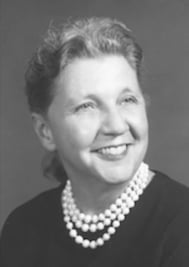 (Leigh Brackett)
For sensitive viewers: This is not a gentle movie, as it might be PG-13 today for the violence. One young character knows he’s bleeding to death, so he shoots himself offscreen. The movie is not visually explicit, but there is plenty of shooting and the intensity is point-blank.
Coming up…
I enjoyed reading your comments on your favorite Star Wars movies last week. My very favorite is coming up next. It’s not Episode VI (Return of the Jedi). That was my favorite when I saw them as a kid. Its cute Ewoks, green forest world, and triumph of good over evil are still classic, but as Yoda says, “There is another.” In its stead, I recommend watching this scene.