Stories Are About Searching: Apartment for Peggy (1948)

Nathan McBride
Apartment for Peggy (1948; YouTube: high video quality or a little blurry with subtitles)
For a year, a friend named Barbara has been recommending that I watch Apartment for Peggy (1948). I knew nothing about it, so I assumed it was a light romantic comedy, which isn’t typically my genre. Barbara and her husband are going to host me for a couple of nights this month, so I decided to give it a watch so that we could talk about it. It turned out to be the best new movie I have seen for over a year, and I have decided to put my pre-planned schedule on hold so as to dedicate today’s blog to this outstanding film, why I like it, and what it shows about good stories.
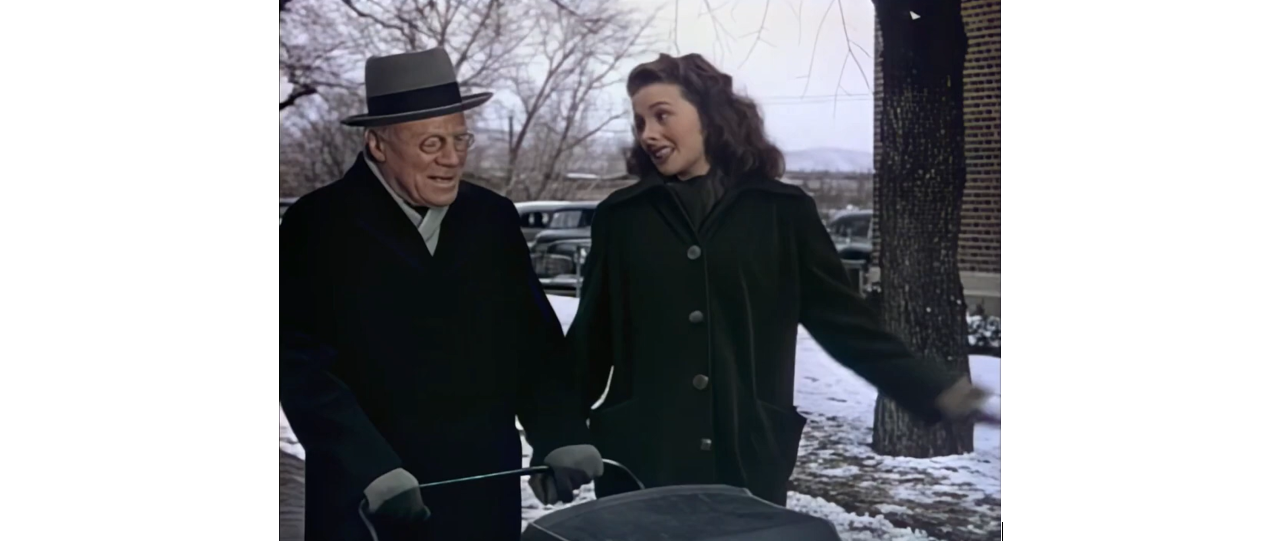
Apartment for Peggy isn’t light, but there’s a lot of light in it. It’s about an aged philosophy professor who, having reached his final year as an instructor, no longer having a family to care for and having no further work to do, has decided to end his life. But he meets—you guessed it—Peggy, the young wife of a recent World War II veteran who is studying at his university. They need a place to live, and she’s going to have a baby, and… well, I won’t leapfrog ahead too far, but you get the premise.
This movie is in color—the first of its many surprises. It features some nice tricks, like being willing to film the characters in the pitch dark when a fuse breaks or panning from one side of the room to another as Peggy’s husband shows our professor (and us?) around. I recognized none of the actors, but this was for the best, because they play their parts more than believably and leave no glaring trace of star persona between themselves and their characters. But most of all, the writing is surprisingly deep. Some of the scenes start to feel like there’s something poetic going on—lighting the room after the lights go out isn’t just about the fuse box. The movie feels three-dimensional. And this is important, because it’s about a problem that can’t be tackled directly. There’s no simple solution, because death is always the simplest “solution”—unless, of course, we realize it’s too simple an equation. Peggy, like this movie (notice the bassinet punch-line), does an excellent job expanding our window of vision, taking things into three dimensions.
The “answers” are true, but they aren’t simple. “Is a thing good in itself, or only when it has the desired effects?” This is what philosophy is for—realizing we don’t have the full answer yet, that we have to look at the world in three dimensions. And this is what makes for good storytelling—and storylistening.
It’s good storytelling because no scene ends with a simple smiley face. I kept expecting these, and the movie kept surprising me. Joy, heart, truth, hope, yes—empty harmony, no. Joy and hope and truth are truer than that, like this script. Like these characters, and their world. True, but complex, multi-faceted, even flawed.
So the script doesn’t tow the line, with one character giving a perfect answer and then everyone walking off smiling. It’s more honest than that. The script lets the professor be honest about his plans and his reasons, and this makes us and everyone around him uncomfortable. Peggy gives a new insight—and characters walk off wondering about it, or challenging the “trick” it’s based on. They keep rethinking where the lines are drawn. Honestly searching. As the professor suggests, pleased at his new friends’ intellectual curiosity, “Wondering is very important. I’ve always felt that if college did nothing more than teach a person to ask why, it’s served its purpose.”
I propose that this is what stories are for, too. They’re not just supposed to tell us the answer—to “instruct” us, as the professor says—but to “educate.” Not just what to think, but how to get there. Otherwise, a movie could be summed up in one or two sentences: here’s the point, get it, got it, good. No, a story is a journey, a search for a fuller answer. If the answers were simple, we would have them already and we wouldn’t need a movie, or a book, or a multitude of Scriptural stories and poems. But the answer is never something we can simply “have.” It is something we have to find, which means it is something we have to look for, because it has to get inside us to make any difference at all. It will only get inside us if we open our eyes, our minds, and our hearts to receive it.
And we won’t do that unless we realize we don’t have all the answers and that we have to work to find them. This is what philosophical thinking is good for, as this movie so wonderfully shows. The answers to life aren’t so simple that they can be spelled out in an instruction manual, and even if they were, they would mean little to us sitting there in complicated print (the bassinet again). The answers must be encountered, questioned, argued with, internalized and lived.
This is what a story is: It is a process, a journey from one stable state of affairs to another (thanks, Paul Ricœur). Story is the process of change, of changing. This is why good stories change us. We change along with them; or they provoke us to question them, which is also part of the process of changing. They don’t lecture at us. They make us curious—curious enough to want to search out the answers. To stay open—to keep walking.
Apartment for Peggy does an excellent job keeping its characters three-dimensional. Characters don’t just lecture at each other, as though one (the movie) were right and the other (us) were wrong. They dialogue, as Mikhail Bakhtin showed me. They all have parts of the whole, but no one person or perspective is the whole alone. This is why we need each other. Like members of an orchestra. No one’s story—or life—is complete alone.
So, keep listening to new stories (and old ones, of course). Because you know, stories are play, like that pool table the professor lectures philosophy from. As Mister Rogers sings, “You can try out life by pretending.” It’s a million times better to try life out on “Mr. Hypothetical” first, before trying it out yourself. Thinking is play, and wondering is freeing, and searching is the way to find. Keep searching, and questioning what you find, not because you’re dissatisfied or incomplete, but because you’re curious—and honest. Stay curious, interested, asking, wondering. Keep wondering. Keep searching.
This movie isn’t the final word, of course (blog’s over!!). No: no movie tells “the whole story,” not even Apartment for Peggy (though it comes close). It only gets 9 stars out of 10 for me because there’s no spirituality in it. But it spoke to me about teaching (my job), and I think it will speak to you, too. It’s a three-dimensional film. Practically perfect in every way. It will make you think and feel. It’s like a vitamin pill for the mind and heart.
Thank you, Barbara.
For sensitive viewers: As you gathered from the premise, this is a movie for adults. And teenagers, come to think of it. There’s no language, no alcohol, just brief dialogue about a woman concerned her husband is unfaithful, and no violence. That is, besides its dynamite script, which may blow you up before it puts you back together, more complete than you were before.
P.S.: I feel like I can count on one hand the number of movies I’ve seen that deal with the struggles and questions of aging, even though this is a challenge pretty much all of us will face. There are plenty of movies (from this same period) about A Matter of Life and Death (1946) and how It’s a Wonderful Life (1946) so it’s worth finding a way forward after war (Rashomon, 1950). But Apartment for Peggy explores answers more complex and more challenging than “all you need is love” or “you have friends and you make the world a better place” or “life goes on as hope rises anew like the sun.” All of these answers are quite true and moving, and It’s a Wonderful Life is a rare 10-star movie for me. But this one is more like Umberto D (1952), and Up (2009), and even Toy Story 4 (2019), because when we get older, things change. It’s not just about youth; it’s about becoming young again—not just like we used to be, but more than we were before.